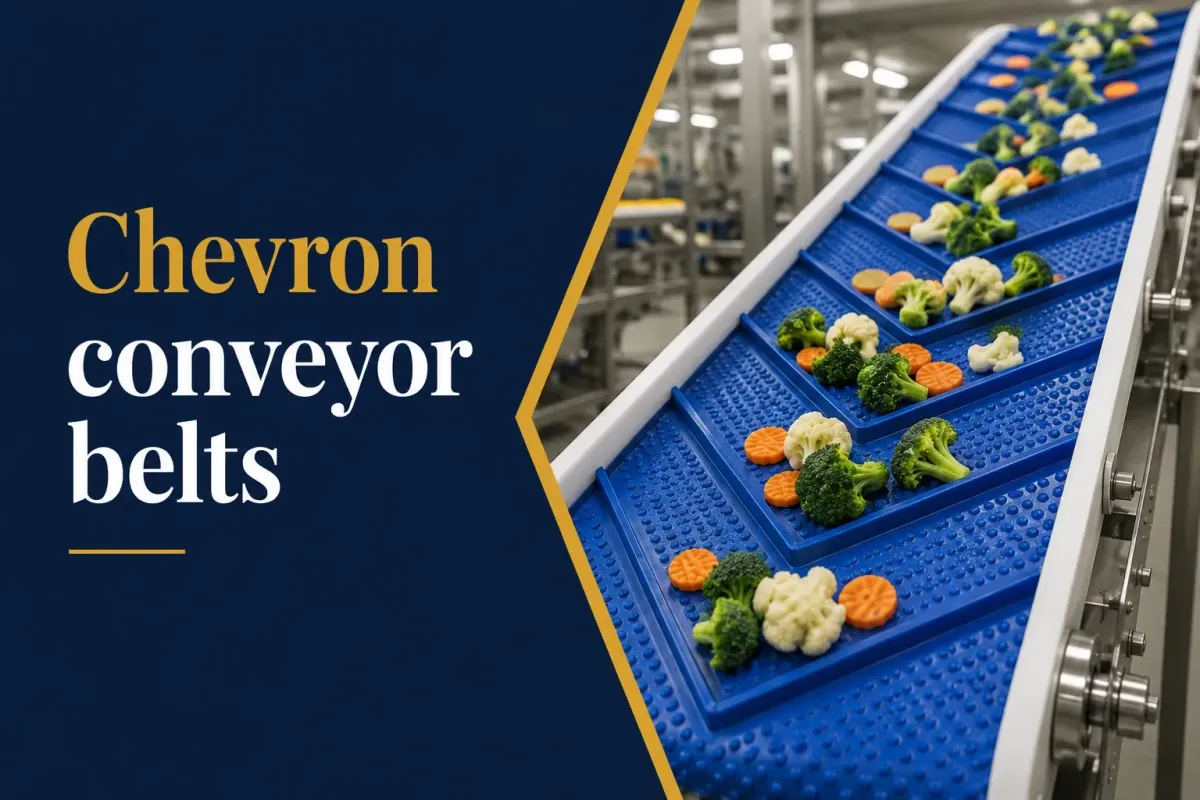
Once a conveyor tilts beyond a certain angle, a flat belt stops being enough, product slides back down as fast as it goes up.
Chevron belts solve that with a moulded pattern built into the belt surface itself, giving loose or bulk material something to grip on an incline that would otherwise beat a smooth belt.
If you're moving material up a slope and need to know which pattern actually suits your application, here's what you need to know.
What is a chevron conveyor belt?
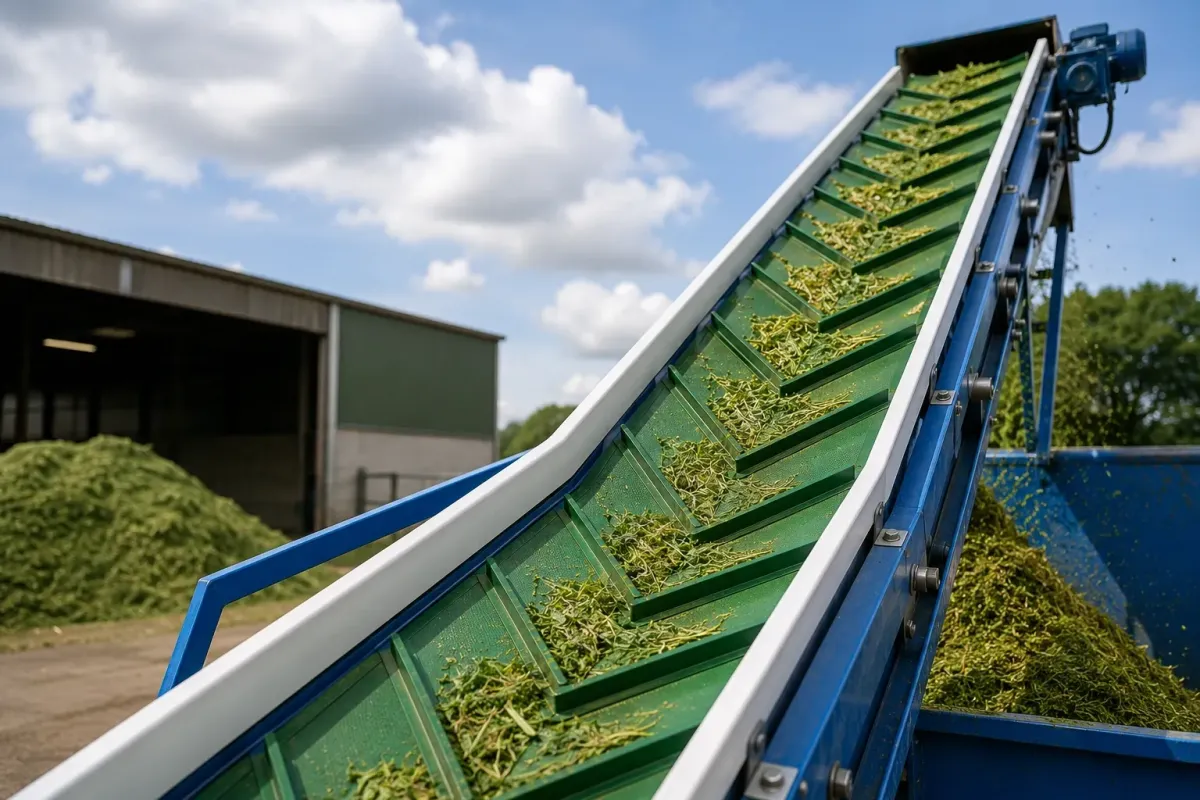
A chevron conveyor belt is a standard PVC, rubber, or food-grade belt with a raised pattern moulded directly into its top cover, usually a V-shaped or arrow-shaped profile, running across the belt at regular intervals.
That pattern is what gives inclined conveying its grip, without it, a smooth belt relies purely on friction, and friction alone runs out fast once the angle steepens.
Chevron patterns aren't the same as cleats.
Cleats are separate, taller strips fixed perpendicular to the belt, generally used for steeper inclines or bulkier loads.
Chevron profiles are shallower and moulded into the cover as part of the belt itself, suited to moderate inclines and a wider range of material types.
Which one you actually need comes down to your incline angle and what's moving across the belt, not just "which one looks more heavy duty."
Get the pattern and base material right and you can run a much steeper incline than a flat belt would allow, often saving real floor space in the process.
Get it wrong and you're either losing product back down the slope or paying for a pattern more aggressive than the job needs.
Benefits of chevron conveyor belts
Prevents rollback
The moulded pattern grips loose or bulk material on an incline that would simply slide back down a flat belt.
Steeper inclines, less floor space
A correctly specified chevron profile lets you run a steeper angle than a flat belt would manage, useful where floor space is tight.
Reduces spillage
Material held on the belt properly means less product lost over the sides or back down the incline during transit.
Extends usable conveyor design
Incline handling that would otherwise need a completely different conveyor layout can often be solved with the right chevron spec instead.
Available on PVC or rubber
The chevron pattern moulds onto either base material, so you're not limited to one belt type just because you need incline grip.
Multiple pattern options
Chevron, cleated, and rough-top profiles each suit different incline angles and material types, it isn't one-size-fits-all.
Repairable and spliceable
Like standard PVC and rubber belts, chevron belts can be repaired and joined by a specialist, the pattern doesn't change how the belt is serviced.
Works with loose and bulk materials
Grain, aggregate, packaged goods on a slope, chevron profiles handle a wide range of product types.
Common industries
Industries that use chevron conveyor belts
Quarrying and aggregates
Moving crushed stone, sand, and gravel up an incline from crushers and screens, where a flat belt simply can't hold the load.
Agriculture
Grain, feed, and root crop handling, particularly on portable and incline conveyors used at harvest.
Mining and extraction
Bulk material moved over long inclined runs, often specified alongside high-tensile carcass constructions.
Recycling and waste
Mixed, loose material moving through sorting and transfer lines that include inclined sections.
Packaging and distribution
Boxes and packaged goods moving up an incline between levels of a warehouse or distribution facility.
General bulk handling
Any operation moving loose material between levels, silos, hoppers, and elevated loading points among the most common.
Choosing the right chevron conveyor belt
Chevron belts fail early for a specific, avoidable reason: the pattern doesn't match the incline or the material.
Here's what to get right.
Why choose Yorkshire Conveyor Belts?
We make finding the right conveyor belt specialist simple.
Finding the right supplier shouldn't mean ringing five different companies or hoping you've found the right one.
We're not a supplier.
We connect Yorkshire businesses with conveyor belt specialists who are, people who supply, install, and maintain chevron belting across the region and know how to match a pattern to an incline rather than just sell whichever one's in stock.
Tell us what you need and we'll match you with someone who can actually help.
We cover Leeds, Sheffield, Bradford, Hull, Doncaster, Wakefield, and the wider Yorkshire area.
Why businesses use us
🏆Trusted local specialists
Vetted conveyor belt experts across Yorkshire.
⚡24-hour response
Fast replies when production can't wait.
🛡No obligation
Advice first. Decide when you're ready.
🏭Industrial expertise
Warehousing, manufacturing, food and logistics.
🏭Fast, simple process
Complete one 2-minute survey
✔Right specification
We help you avoid costly mistakes.
📍Yorkshire coverage
Leeds, Sheffield, Hull, Bradford, Doncaster and beyond.
Still need help choosing the right belt?
Chevron conveyor belt FAQs
Need a chevron conveyor belt in Yorkshire?
What are chevron conveyor belts used for?
Any application moving loose or bulk material up an incline, quarrying, recycling, agriculture, packaging, and mining among the most common. Anywhere a flat belt would let product slide back down the slope.
What's the difference between chevron and cleated conveyor belts?
Chevron patterns are moulded into the belt's cover as part of the belt itself, generally suited to moderate inclines. Cleats are separate, taller strips fixed to the belt, typically used for steeper inclines or bulkier loads. Which one you need depends on your specific incline and material, not which sounds more heavy duty.
Can chevron belts be made from rubber or only PVC?
Both. The chevron pattern moulds onto either base material, so the choice between PVC and rubber comes down to the same factors as a flat belt, load, abrasion, and environment, rather than being limited by the pattern itself.
At what incline angle do I need a chevron belt?
As a general guide, beyond roughly 15 to 18 degrees, a flat belt starts losing product back down the incline. Wetter or more free-flowing material can need the fix at a shallower angle still. A specialist reviewing your actual conveyor will give a more precise answer than a general rule of thumb.
How long do chevron conveyor belts last?
Similar factors to a standard belt of the same base material, load, abrasion, and maintenance, plus one extra: the pattern itself wears over time and can lose grip before the underlying belt is finished. Regular inspection of the pattern specifically extends useful life.
What maintenance does a chevron conveyor belt need?
The same tracking, tension, and surface checks as any conveyor belt, plus regular inspection of the pattern's condition. A worn-down chevron profile causes rollback long before the belt itself needs replacing, so catching pattern wear early matters more here than on a flat belt.
Replacement belt, new incline installation, or help working out which pattern actually suits your setup, whatever you're working through, we can connect you with a Yorkshire specialist who can help. Tell us what you need.