
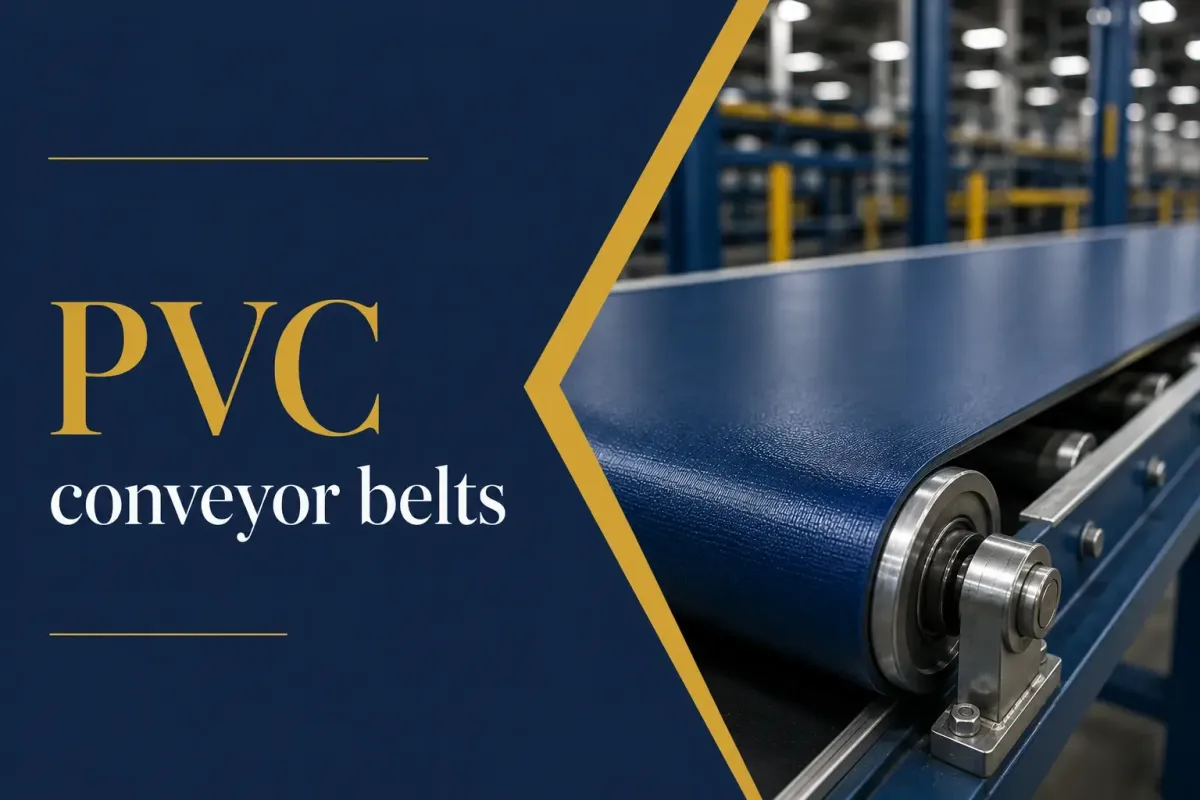
PVC conveyor belts are the default choice across UK warehousing, food production and manufacturing — not because they're flashy, but because they work.
Durable, easy to maintain, available in dozens of specifications.
If you're sourcing a replacement, planning a new installation or deciding whether PVC is the right conveyor belt for your application, here's what you need to know.
What is a PVC conveyor belt?
PVC stands for polyvinyl chloride, a synthetic plastic used in industrial applications because it handles wear, flex and everyday punishment without making a fuss.
The belt itself is a reinforced textile core (usually polyester or nylon) with PVC compound bonded to one or both sides. The core carries the load; the PVC surface does the actual work, smooth, textured or profiled depending on what the belt needs to do.
You'll find PVC belts in warehouses, food production lines, packaging facilities and logistics operations. They're a solid, practical choice. But "PVC belt" covers a wide range of specifications, and the difference between one that's right for your application and one that isn't shows up fast. Wrong thickness, wrong surface, wrong compound — and you're looking at shortened belt life, product slippage or downtime you didn't budget for.
Get the spec right from the start and you won't think about the belt again for years. Get it wrong and you will.
Benefits of PVC conveyor belts
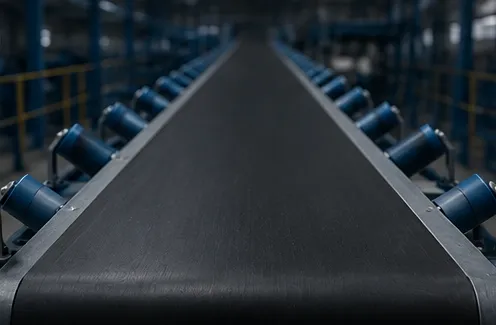
Durable
Holds up well under high usage, abrasion and the general punishment of a working industrial environment
Low maintenance
Smooth surface, easy to inspect and clean, doesn't need much attention when it's correctly specified and running well
Cost effective
Cheaper than rubber or specialist alternatives in most standard applications, without sacrificing performance where it matters
Food safe options
Food-grade PVC formulations exist for direct and indirect food contact; not all PVC is food-grade, but the right spec is widely available
Good grip options
Surface finish is specifiable: smooth for stable packaged goods, textured or cleated for incline work or awkward products
Easy to clean
Non-porous surface doesn't hold onto dirt or moisture; food-grade versions are built specifically for washdown
Decent service life
A correctly specified PVC belt in a typical warehouse environment will often run 3–5 years before replacement is needed
Repairable
Edge wear, small tears and tracking damage can often be fixed on-site by a specialist rather than pulling the whole belt
Common industries
Industries that use PVC conveyor belts
Warehouse & distribution
Pick, pack and despatch operations — parcels, boxes, palletised goods moving through the facility at volume.
Food manufacturing
Ingredients, packaged products and finished goods on production lines. Food-grade PVC is standard here for anything with direct or indirect food contact.
Packaging
Bottles, cartons, pouches, components — lines where consistent belt speed and surface grip keep things running predictably.
Recycling
Sorting and transfer lines where the belt takes a beating from varied materials and irregular loads.
Pharmaceutical
Clean environments, hygiene-sensitive applications, surface integrity requirements. PVC handles this well when specified correctly.
Logistics
Parcel sorting, distribution centre throughput — high volume, no room for unexpected stoppages.
Airports
Baggage handling and check-in conveying. Continuous demand, no tolerance for unexpected stops.
Manufacturing
Components, sub-assemblies, finished goods moving along production lines across almost every manufacturing sector.
Choosing the right PVC conveyor belt
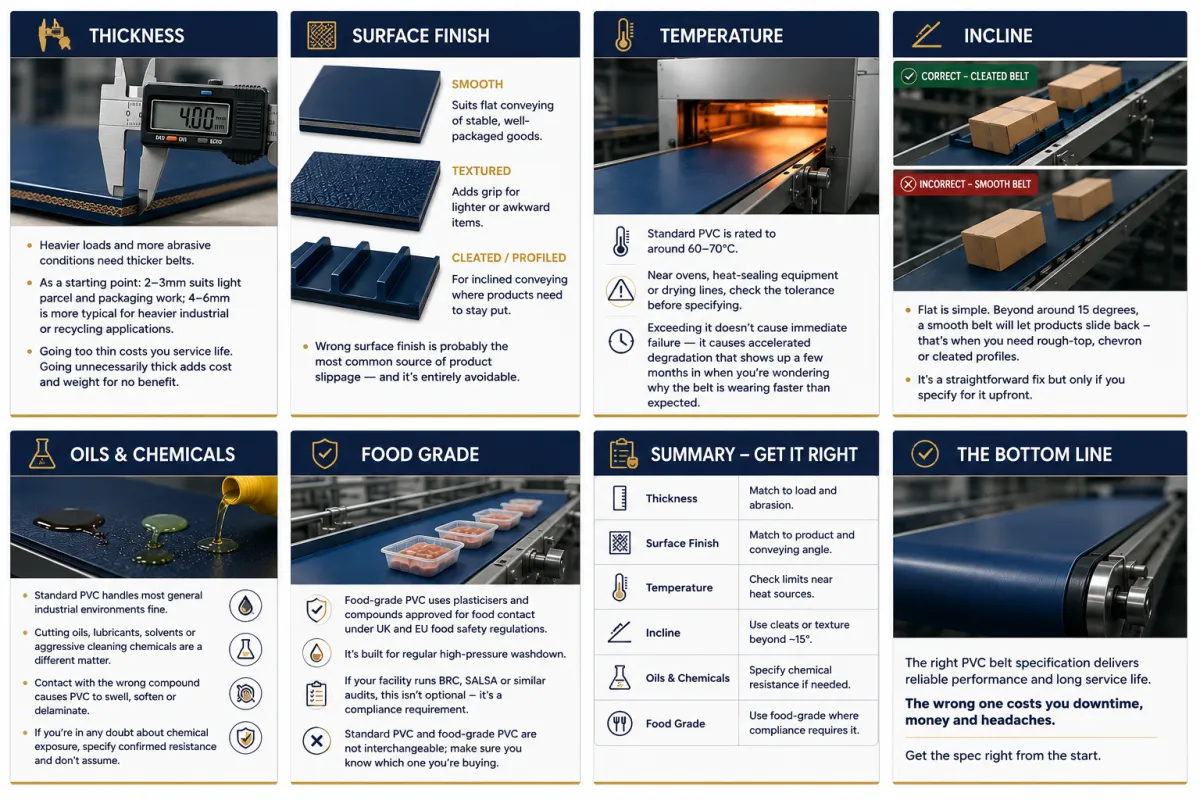
Most early belt failures trace back to the same root cause: the belt wasn't right for the job. Not defective — just wrong for the application. Here's what to get right:
Why choose Yorkshire Conveyor Belts?
We make finding the right conveyor belt specialist simple.
Finding the right supplier shouldn't mean ringing five different companies or hoping you've found the right one online.
At Yorkshire Conveyor Belts, we connect businesses across Yorkshire with conveyor belt specialists who've done this work before and have the capacity to actually take your job on.
Why businesses use us
🏆Trusted local specialists
Vetted conveyor belt experts across Yorkshire.
⚡24-Hour response
Fast replies when production can't wait.
🛡No obligation
Advice first. Decide when you're ready.
🏭Industrial expertise
Warehousing, manufacturing, food and logistics.
🏭Fast, simple process
Complete one 2-minute survey
✔Right specification
We help you avoid costly mistakes.
📍Yorkshire coverage
Leeds, Sheffield, Hull, Bradford, Doncaster and beyond.
Still need help choosing the right belt?
PVC conveyor belt FAQs
What are PVC conveyor belts used for?
PVC conveyor belts are used across a wide range of industries to move goods, components and materials along a production or distribution line. Common applications include warehousing, food processing, packaging, recycling, pharmaceutical manufacturing and logistics operations.
Are PVC conveyor belts food safe?
Food-grade PVC conveyor belts are available and widely used in food manufacturing and processing environments. These belts use compounds approved for food contact and are designed for regular cleaning and washdown. Always confirm the belt specification is food-grade if hygiene compliance is required — standard PVC is not the same as food-grade PVC.
How long do PVC conveyor belts last?
Service life varies significantly depending on the application and how well the belt is maintained. In a typical warehouse or distribution environment with routine maintenance, a correctly specified PVC belt will often last 3–5 years. High-load, abrasive or chemically exposed environments will shorten that considerably.
The most common reasons belts fail early are incorrect specification for the application, lack of routine tracking and tension checks, and exposure to conditions outside the belt's rated tolerance.
Can PVC conveyor belts be repaired?
Yes — and in many cases repair is the faster and more cost-effective option. Minor edge fraying, small tears, localised surface wear and tracking damage can often be repaired on-site by a belt specialist using hot or cold vulcanising techniques.
A specialist will assess whether repair is practical based on where the damage is, how extensive it is, and how much usable belt life remains. If the belt is close to end of life, replacement is usually the better long-term choice.
How do I choose the right conveyor belt?
The right belt depends on your application — what you're moving, the load weight, operating environment, incline, temperature and any hygiene requirements. The specification factors covered in the section above are a good starting point.
For anything beyond straightforward flat conveying of standard packaged goods, speaking to a specialist who can review your actual setup will save time and avoid costly misspecification.
Are PVC conveyor belts suitable for wet environments?
PVC belts handle light moisture well. For food production environments with regular washdown, food-grade PVC belts are specifically designed for this and are widely used. For heavily wet industrial applications — wet aggregate processing, outdoor use or continuous immersion — rubber belting is usually the more appropriate choice.
If in doubt, describe your actual environment to a specialist rather than assuming PVC will suffice.
What maintenance does a PVC conveyor belt need?
Routine maintenance for PVC belts typically includes checking and adjusting belt tension, inspecting and correcting belt tracking (to prevent edge wear from the belt running off-centre), cleaning the belt surface and removing any material build-up on rollers or pulleys, and inspecting for early signs of surface wear, edge fraying or delamination.
Most of these checks can be done quickly during routine facility maintenance rounds. Catching minor issues early — particularly tracking problems — significantly extends belt life.